Arduino Nano simulator, in the breadboard
Mokxi is a free Arduino Nano simulator that runs in your browser, with nothing to install and no account needed. The Nano is the Uno's ATmega328P on a board small enough to push into a breadboard. Wire the circuit, write the sketch, press Run: the firmware runs on our own AVR core, not on an interpreter standing in for one.
- 505parts on the bench
- 45boards running now
- 1.00xreal time, on every board
The numbers, not the marketing
Taken from the board's own contract document and put in plain words.
| The core | Every ATmega328P mnemonic, at 16 MHz, with the datasheet cycle count for each one. The same chip as the Uno, so the same firmware runs on both. |
|---|---|
| Timers and I/O | Three timers in every waveform mode including hardware PWM, USART0, external and pin-change interrupts, sleep and EEPROM, and an eight-channel ADC. |
| A6 and A7 | Two analog inputs the Nano's package bonds out and an Uno has no pad for. They read with analogRead and nothing else: no digitalRead, no output driver, no pull-up. |
The full board page
Every peripheral area, every example and the wiring notes, in one place.
Step-by-step guides for the Nano
Each one has the parts, the wiring and the code, and ends in a circuit you can run.
Three steps from a blank tab to a running circuit.
Open the editor
It runs in your browser tab. Nothing to install, and you need no account to start.
Your first projectWire it and write the code
Drag parts onto a breadboard, run each wire from pin to pin, and write the sketch beside it.
WiringPress Run
Your sketch compiles in the tab and runs on a model of the chip, with the Serial Monitor beside it.
Run and serial
Open a project and press Run.
Every one runs in the editor exactly as it is drawn, ready to change.
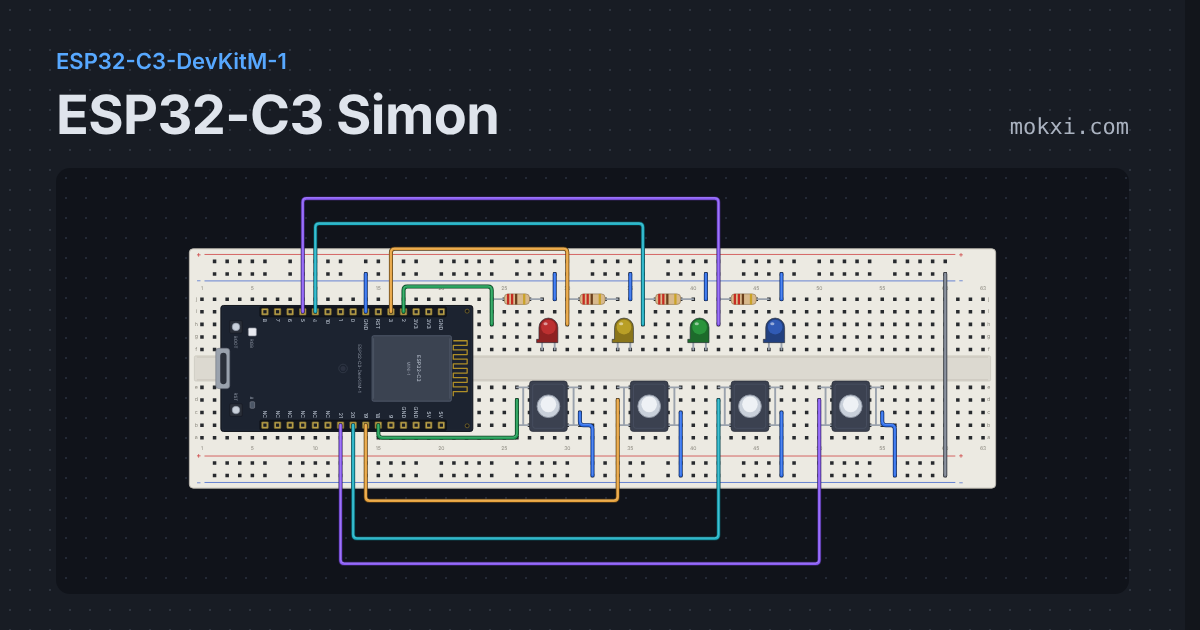
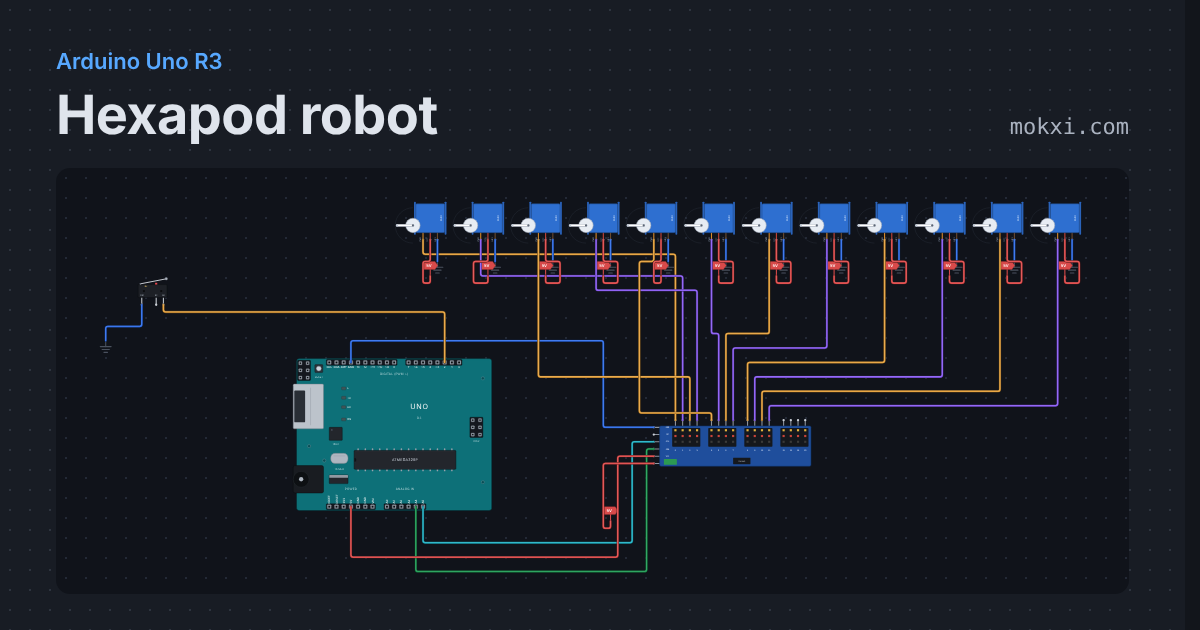
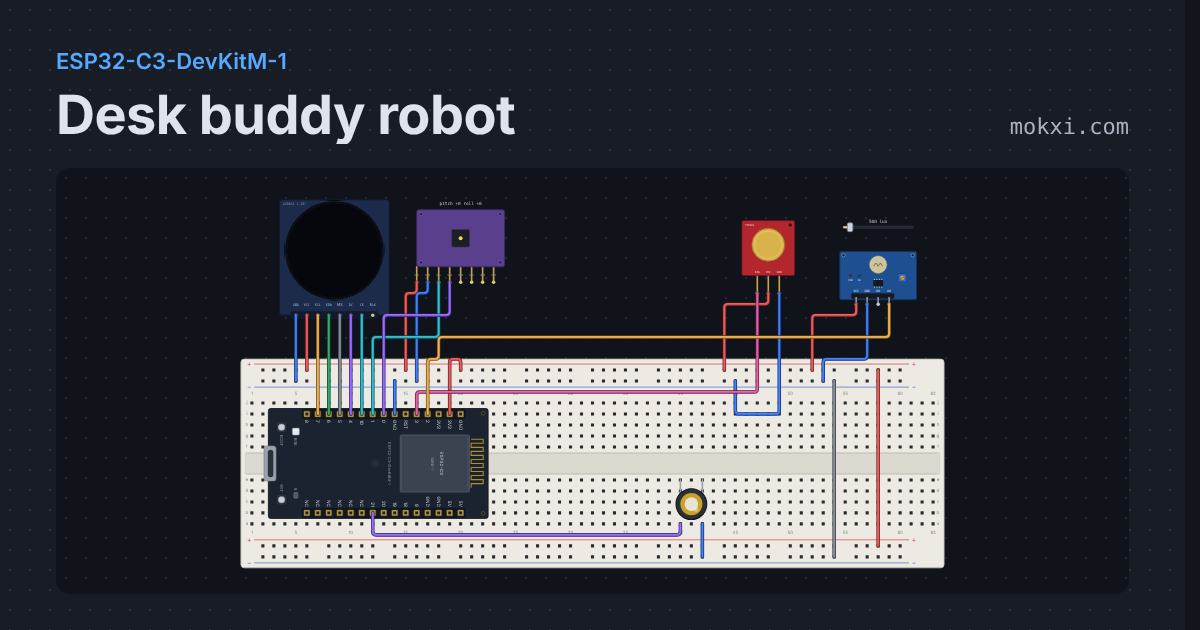
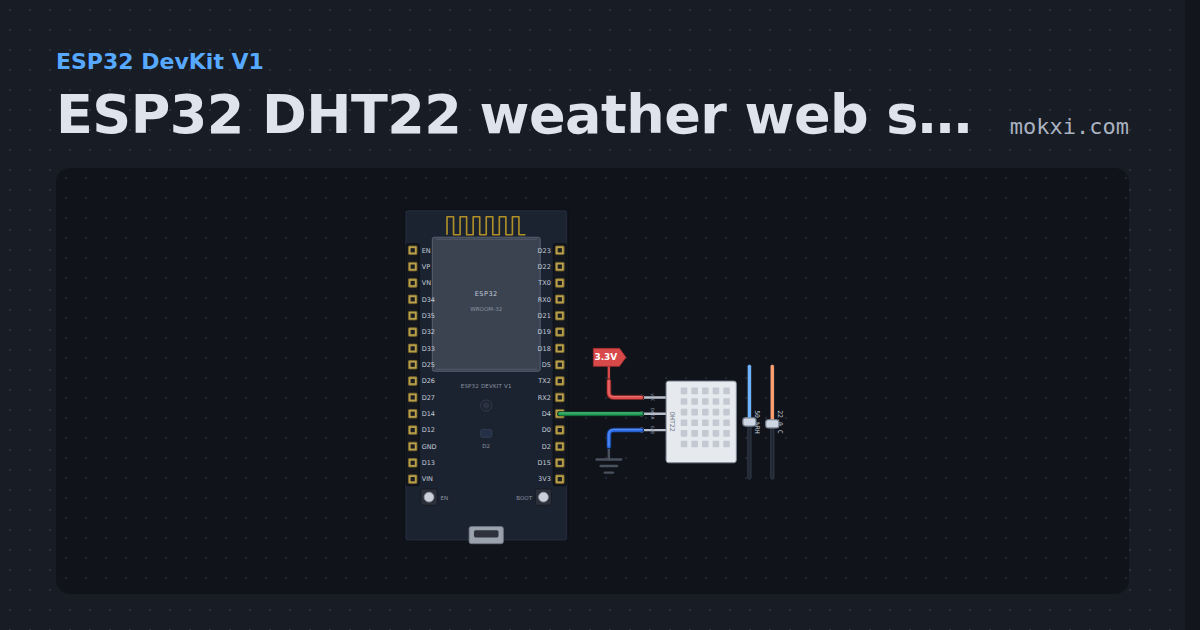
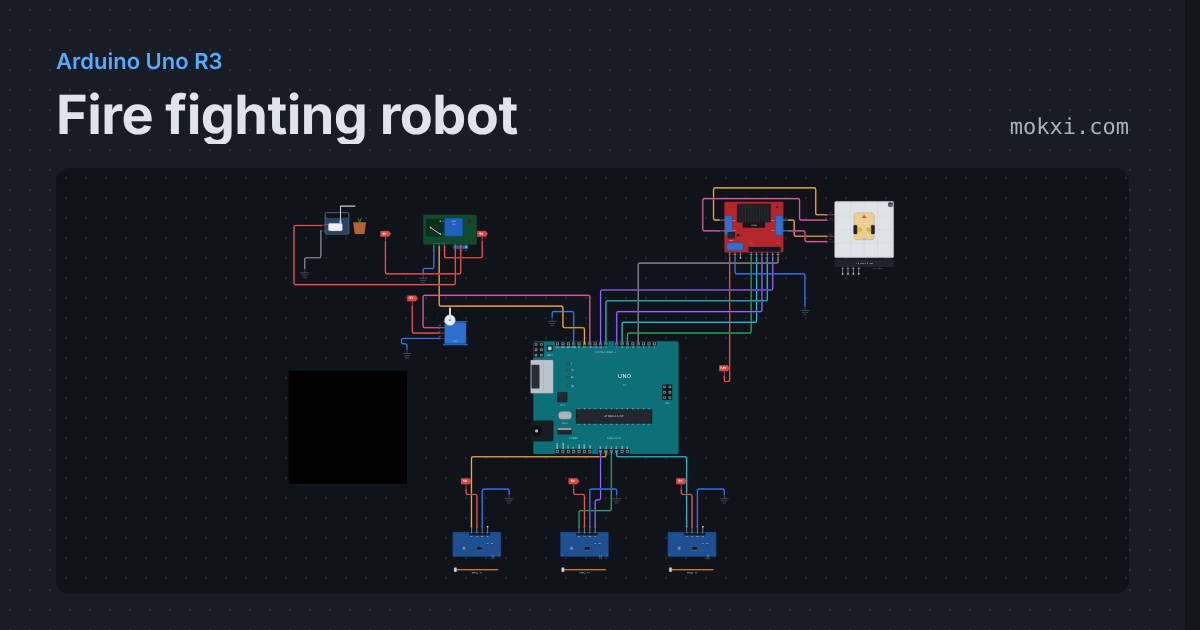
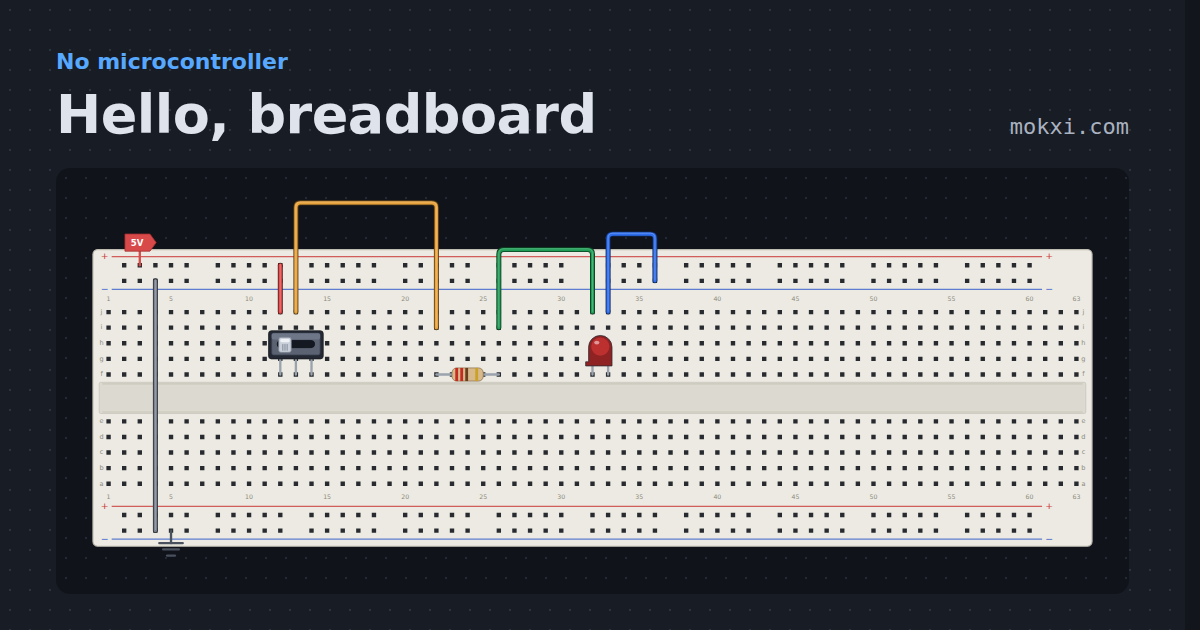
What makers say about Mokxi.
“The AI checker helps check and correct my circuits, and it has way more components than Tinkercad. As a student I really appreciate the tool.”
“I’d been looking for a real online electronic simulator that was intuitive and complete when I found Mokxi. I was able to quickly import a Fritzing file and my Arduino sketch and start testing. Mokxi has all of the makings for the best online Arduino simulator I have been able to find!”
“I’m using Mokxi to develop and simulate an STM32-based four-wheel-drive robot car before building the actual hardware. It allows me to experiment with DC motor control, PWM, RPM measurement using photointerrupters, and different acceleration, braking, and reversing strategies, helping me understand and refine the system before implementing it in real life.”
Questions, answered.
Which Nano does this simulate?
The Nano v3, on the ATmega328P. Not the Nano Every, the Nano 33 or the Nano ESP32, which are other chips entirely.
Is it the same as the Uno simulator?
The same chip, a different board. The Nano pushes into the breadboard and has A6 and A7; everything else, down to the ELF, is shared.
Will my sketch run on a real Nano?
The model uses the real register map for supported peripherals. Test the finished sketch on your Nano before relying on it.
Is it free?
Yes, all of it, with no card and no account needed to try it.
Do I need an account at all?
No. The editor, the templates, the gallery, the compiler and Run all work without signing in. Your browser keeps your work as you go. An account saves your projects online, so they follow you to any computer. It also gives you a link to share.
Which boards are supported?
Forty-five, all on the free plan. Arduino: the Uno R3, Uno R4 Minima and Uno R4 WiFi, Nano, Nano ESP32, Nano RP2040 Connect, Mega 2560, Leonardo, Micro, the Pro Mini in its 5 V and 3.3 V builds, and the SparkFun Pro Micro. ESP32: the classic DevKit V1, the ESP32-S3, the ESP32-C3 and C6 DevKits, the Espressif DevKitC V4, the Freenove ESP32-WROVER, the Wemos LOLIN32 Lite, the Wemos D1 R32, the Cheap Yellow Display, the TTGO T-Display, the ESP32-C3 SuperMini and the Seeed XIAO ESP32-C3, C6 and S3. ESP8266: the NodeMCU, the Wemos D1 mini and the ESP-01S. Also the Raspberry Pi Pico and Pico W, the Seeed XIAO RP2040, the Waveshare RP2040-Zero, the Seeed XIAO SAMD21, the WCH CH32V003, the STM32F411 Black Pill, the STM32 Nucleo-F411RE and the STM32F103 Blue Pill, the BBC micro:bit V2, and the ATtiny85 and the ATmega328P in its 16 MHz and 8 MHz builds, which plug straight into the breadboard as bare chips. Your own code compiles in the browser for all of them. Then the Raspberry Pi 4, Pi 5 and Zero 2 W computers, which run your Python with gpiozero and RPi.GPIO, with nothing to compile. Each board page lists what it can and can’t do. For example, the WiFi boards have pretend WiFi, not a real radio, and the page says so.
Is my sketch really compiled in the browser?
Yes. A real compiler (clang, built for the web) runs in your browser. It downloads once, and your browser keeps a copy. After that, every build happens on your own computer. There is no build server and no waiting in line, so there are no build minutes to run out of.
Which browsers work?
Any up-to-date Chrome, Edge, Firefox or Safari, on a computer, a phone or a tablet. They all support WebAssembly, which Mokxi needs, and they have for years.
Does it work on a phone?
Yes. The editor works with touch, the buttons are big enough to tap, and the layout fits a small screen. The simulation runs on the phone itself.
Can I try Pro before I pay?
Yes. Every account can try Pro free for 7 days, once. It takes a card, nothing is charged for those days, and if you cancel before they end you pay nothing. It starts when you choose it.
Can I cancel anytime?
Yes, in one press from your account page. Your plan runs to the end of what you paid for.
Do you offer refunds?
Yes, once per account. Write to us within 14 days of a payment and we refund all of it. Lifetime Pro is refunded in full within 14 days of buying it.
Is there a student discount?
Yes. Students get Pro at half price with a school email.
Do students need accounts?
No. The simulator works signed out, so your class starts from one link with nothing to sign up for. An account only adds cloud saving and sharing, and a student can make one later, or never.
Does it work on a Chromebook?
Yes. Everything runs on the machine in front of the student, so a Chromebook works as well as a lab PC.
What does it cost for a class?
Nothing, if your students only need to open and run circuits: the whole simulator is on the free plan. The class tools (a roster, starter projects, auto-graded checks, the gradebook) come with Pro and Classroom. Classroom is $9.99 a student a year, from 5 students, so at least $49.95 for the year. Your own seat is free, and from 50 students each one costs less. Your students get Pro’s room while they are in your classes. Pay by card, invoice or purchase order. Pro on its own runs classes for up to 10 students in all. To try the class tools with real students first, start the free 30-day trial from your class page: one class of up to 20 students, no card.
Is student work private?
Yes. A student’s projects in a class are always private: they cannot be opened by link or put in the gallery. One exception, and only for reading: a teacher may open, and never write, a project owned by somebody in a class they teach, which is what a card on the class wall does. What we store about a student, who processes it, how a school has it deleted, and how we handle COPPA consent for students under 13 and FERPA as a school official are all on the student data privacy page at /privacy/students.
Is Mokxi AI free?
Every signed-in account gets questions every day: 5 on a free account, 50 on the Pro trial, 100 on Pro and the other paid plans, and 25 on Lifetime Pro.
Does Mokxi AI work with ESP32 and Raspberry Pi Pico sketches?
Yes. It knows which board the project is on and answers for that board, from an Uno to an ESP32, an ESP8266, a Pico or an STM32.
Can Mokxi AI change my code without asking?
No. It proposes a change as a card. Accept is yours, and only appears once the changed code compiles; Ctrl+Z undoes it.
What does Mokxi AI send with a question?
Your project text, the matching help articles and the last six messages of the chat, never your name or account. "What is sent" shows exactly what went.
Latest arrivals in Mokxi.
Simulators for one kind of circuit
A servo, a display, a motor driver or a rectifier, each already running.
Try your own firmware on the Nano
What you build here runs on the board on your desk, unchanged. Nothing to install and no account needed.