

Mokxi and Falstad’s circuit simulator, compared fairly
Paul Falstad’s circuit simulator, often called CircuitJS, is a free, open-source, browser-based tool for real-time analog and digital circuit simulation with live current and voltage animation. It is built to teach how a circuit behaves, not to run Arduino firmware. Mokxi runs real firmware on a real breadboard. The two are complementary rather than competing on the same job.
- 192parts on the bench
- 25boards running now
- 1.00xreal time, on every board
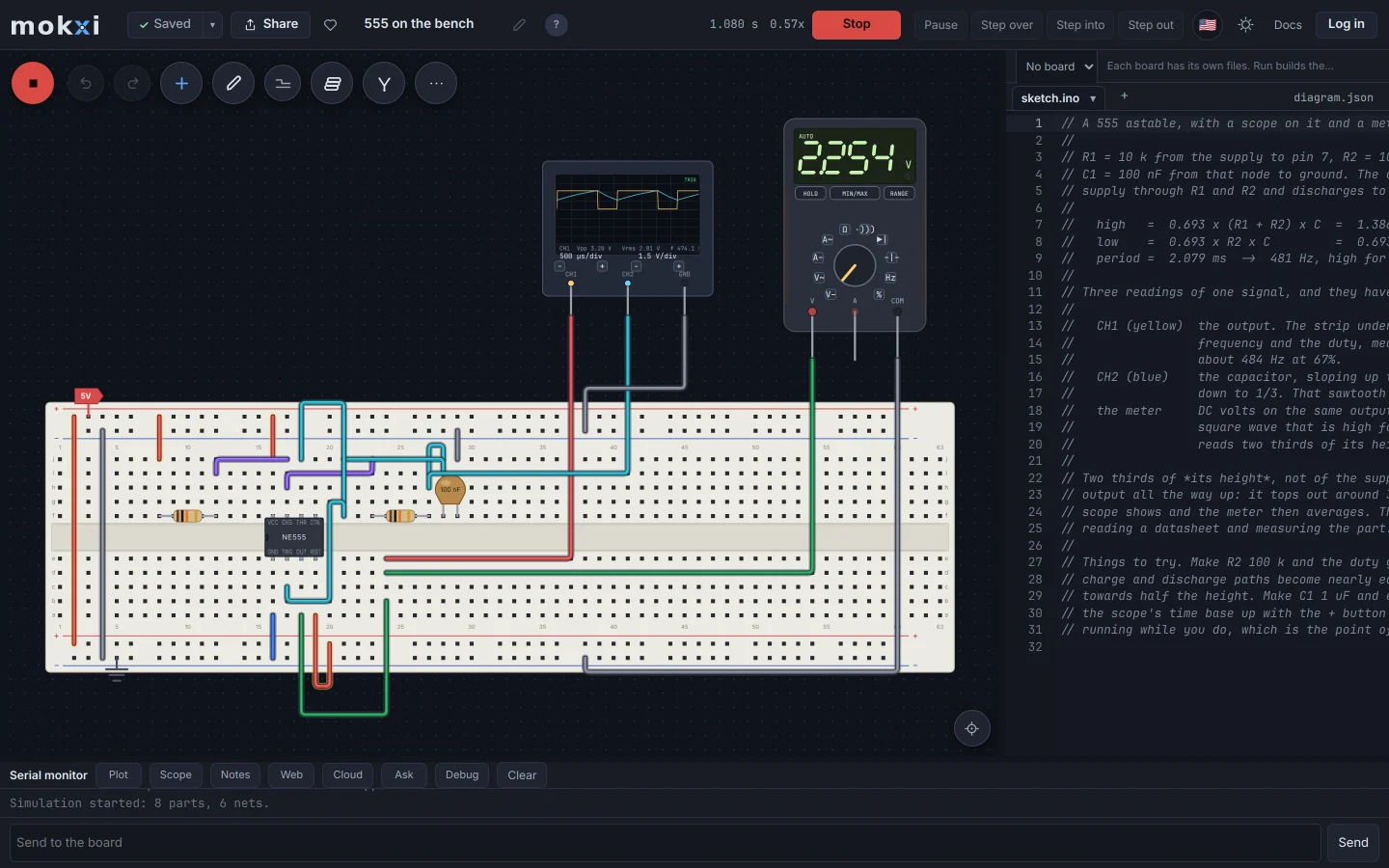
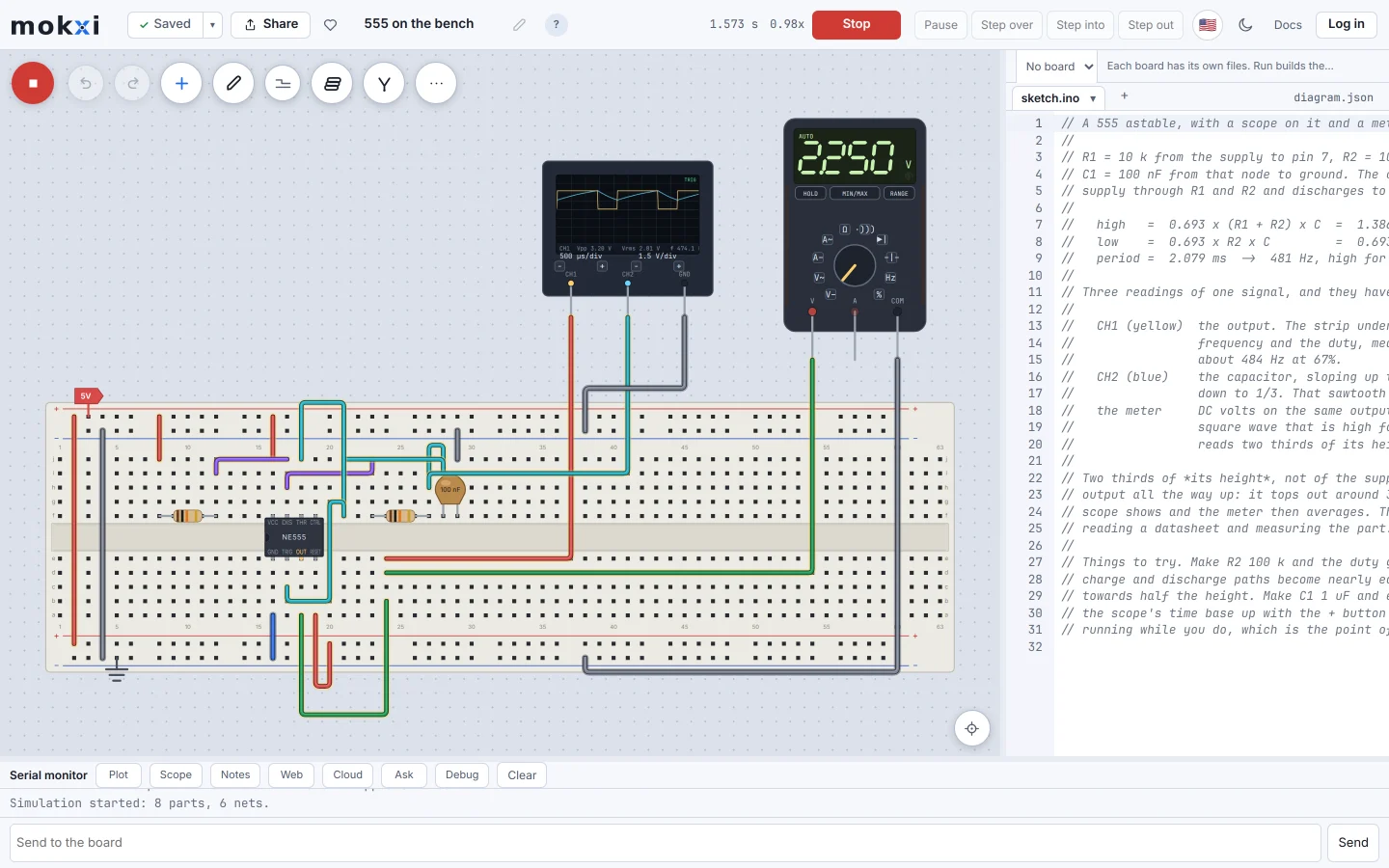
The Mokxi editor running a 555 astable on the bench, with an oscilloscope showing the square wave and a meter reading its average.
Where Falstad (CircuitJS) leads
These are the strongest reasons to choose Falstad (CircuitJS) today.
- Free, open source, and has run in a browser for a very long time, with a huge library of shared, linkable example circuits.
- Excellent live animation of current flow and voltage, which makes it a genuinely strong tool for building intuition about analog and simple digital circuits.
- No account, no boards to pick, and a circuit is shareable as a single link with its state encoded in the URL.
- A broad, general-purpose electronics teaching tool, not narrowed to any one microcontroller family.
Where Mokxi leads
These are working parts of Mokxi you can open and test for yourself.
- Runs real, compiled C++ against a cycle-accurate Arduino Uno or ESP32-C3; Falstad’s simulator has no built-in notion of compiling and executing microcontroller firmware.
- A breadboard at real 0.1 inch pitch, wired the way a physical build is wired, rather than a schematic-style canvas.
- Real parts, including a 74HC595 shift register, an NE555 and 74HC-series logic, alongside a microcontroller on the same board.
- Aimed at people building a specific Arduino or ESP32-C3 project, rather than at general circuit theory.
Side by side
Checked on 2026-09-16. If anything here has gone stale, that is our mistake and we want to know.
Which one should you use
Straight answers. Where the other one is the right call, we say so.
You want to build intuition about a generic RLC or diode circuit
Falstad’s simulator is built exactly for that.
You want to run an actual Arduino or ESP32-C3 sketch
Mokxi. Falstad’s simulator does not run microcontroller firmware.
You want to wire a project on something that looks like a real breadboard
Mokxi.
You want to share a tiny circuit as a single link with no account
Either. Both put the whole circuit in the link, so neither needs an account.
Compare the other options
The same straight comparison for the tools teachers, students and makers also consider.
In short
Should I use Mokxi if you want to build intuition about a generic rlc or diode circuit?
Falstad’s simulator is built exactly for that.
Should I use Mokxi if you want to run an actual arduino or esp32-c3 sketch?
Mokxi. Falstad’s simulator does not run microcontroller firmware.
Should I use Mokxi if you want to wire a project on something that looks like a real breadboard?
Mokxi.
Should I use Mokxi if you want to share a tiny circuit as a single link with no account?
Either. Both put the whole circuit in the link, so neither needs an account.
Try it yourself
A comparison page is somebody else’s opinion. Open the editor, press Run and make up your own mind.