About Mokxi and the person behind it.
Mokxi is a free electronics and microcontroller simulator that runs in your web browser.
About Dane, the human behind Mokxi.

Hey, I'm Dane, the human behind Mokxi. I'm a sophomore in college and a total nerd. I don't really like to leave the house, so I code, study or work pretty much all day and I love it.
I've loved tech, electronics and gaming my whole life, and claw machines most of all. I wanted one since I was a kid but could never afford one. So I built Mokxi, then built my own claw machine in it. You can play it right now.
I'm in college for computer engineering and still deciding between that and computer science, because I love both the hardware and the code. I also hated waiting for parts to show up. Mokxi fixes that. You wire a circuit, write the code and press Run, right in your browser.
I love software because you don't need anyone's permission to build it. That's what I want to do with my life.
Every person who joins Mokxi means the world to me. You've changed my life since we launched. Thank you.
More of what I build is on danedolph.com. Got an idea, or something broken? Write to me. I read every one.
Hope you have fun building!
What it does, by the numbers.
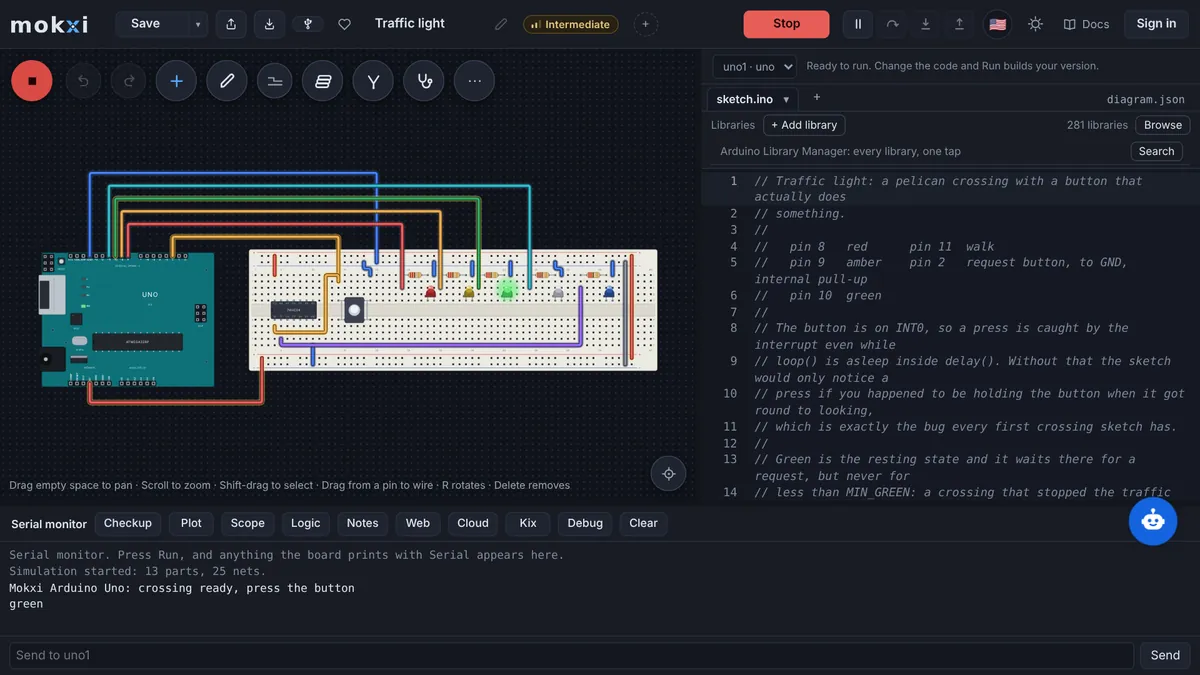
You wire a circuit on a breadboard, write the firmware in C++ as you would for the real board, and press Run. The sketch compiles in the browser tab, and the microcontroller and the circuit run together, in real time, on your own computer.
There is nothing to install and no account is needed to start. It works on Chromebooks, Windows, Mac and Linux computers, and phones.
45 boards
45 boards run today: Arduino boards from the Uno R3 to the Uno R4 WiFi, ESP32 and ESP8266 boards, the Raspberry Pi Pico and Pico W, the Raspberry Pi 4, Pi 5 and Zero 2 W, the Seeed XIAO RP2040 and XIAO SAMD21, the WCH CH32V003, three STM32 boards, the BBC micro:bit V2 and the bare ATtiny85 and ATmega328P. Each board page says what its model covers and what it does not.
505 parts
LEDs, resistors, buttons, 74HC logic chips and the NE555, sensors, displays, motors, servos and robot parts such as a car chassis, a line tracker and a robot arm, and bench instruments such as an oscilloscope and a multimeter.
Analog and digital
Analog parts of a circuit are solved by nodal analysis with real device models, and SPICE decks run in the editor on an engine checked against ngspice. For digital logic there is a logic gate simulator and a learning path that builds a computer from NAND gates.
Who it is for: students, teachers and makers.
The free plan is the whole simulator. Pro and Classroom add room and classroom tools; pricing has the details.
Students
Students learning electronics and programming. It is written in US English and built with US schools in mind, and it works the same for students and makers in any country, in any modern browser.
Teachers
Teachers running a class without a box of parts for every desk. Teachers get class rosters, assignments and checks that grade each submission, and a free 12-week Arduino course.
Hobbyists
Hobbyists trying an idea before they buy the hardware: wire it, run it and see it work, then order the parts.
Who makes it, and where.
Mokxi is made by Mokxi LLC, a Colorado company in Colorado Springs. The simulator, its CPU cores and its board models were written here, from the ground up.
What's new
What has shipped is on what's new, with a line for each change the day it went out.
Questions people ask.
What is Mokxi?
Mokxi is a free electronics and microcontroller simulator that runs in your web browser. You wire a circuit on a breadboard, write the firmware in C++ as you would for the real board, and press Run: the microcontroller and the circuit are simulated together, on your own computer.
Is Mokxi free?
Yes. Every board, every part and the whole simulator are on the free plan, with no card and no account needed to start. Pro adds sending to a real board, private projects, save history and more of Mokxi AI, and Classroom adds the class tools.
Who makes Mokxi?
Dane, through Mokxi LLC, a small company in Colorado Springs, Colorado, in the United States. The simulator, its CPU cores and its board models were written here rather than borrowed.