Galvanic skin response sensor
Two finger straps and an op-amp: sweatier skin conducts more, and the reading falls.
- 3 pins
- In 1 project
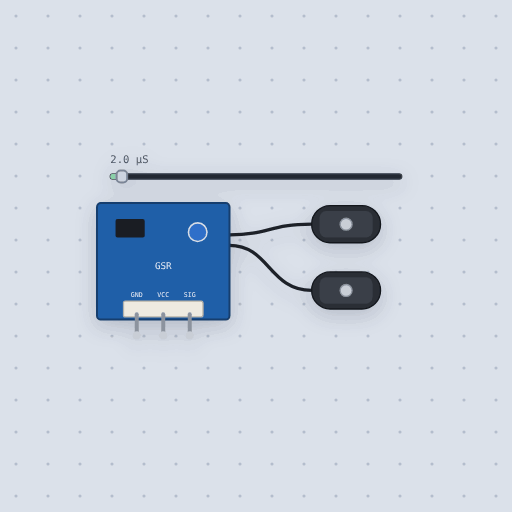
The Galvanic skin response sensor in brief
What it is, and where it sits on the bench.
The galvanic skin response sensor is the Grove GSR module: two finger straps on a lead and a small board that turns your skin’s conductance into a voltage. Skin conducts more when it sweats, even slightly, and the board puts a small voltage across the straps and an op-amp turns the current into SIG. The pins are GND, VCC, 3.3 V to 5 V, and SIG, ratiometric to VCC: half the supply with no fingers on the straps and lower as the skin conducts more. The reading follows the module’s published formula R = (1024 + 2x) x 10 k / (512 - x), so open straps read 512 on a 5 V Arduino. A slider sets the conductance in microsiemens. It is not a lie detector, and nothing is.
- Family
- Sensors
- Pins
- 3
3 pins
Named as the editor names them, so a wire lands where you expect it.
VCC: half the supply with no fingers on the straps, lower as the skin conducts more.How to read a GSR skin response sensor with an Arduino
The module has three wires: VCC to the Uno’s IOREF, which is its 5 V, GND to ground and SIG to A0. Skin conducts more when it sweats, and the module reads lower as it does, so open straps read 512 and a calmer finger reads higher than a sweaty one. The sketch turns the reading into microsiemens with the module’s own formula: ohms = (1024 + 2x) x 10 k / (512 - x), then 1 000 000 divided by ohms.
This is a science fair demo of the stress response, not a lie detector. Skin conductance and heart rate rise with surprise, effort and laughter as readily as with a fib. The sketch learns a calm baseline for 10 seconds when you press the calibrate button on A3, adds a MAX30102 heart rate, and shows how far the body has moved from baseline on a ten segment LED bar on pins 2 to 11. Drag the GSR slider up to see it.
const uint8_t GSR_PIN = A0;

float readSkin() {
  int x = analogRead(GSR_PIN);
  if (x >= 505) return 0;          // open straps read 512
  float ohms = (1024.0 + 2.0 * x) * 10000.0 / (512.0 - x);
  return 1000000.0 / ohms;         // microsiemens
}

void setup() {
  Serial.begin(115200);
}

void loop() {
  Serial.println(readSkin());
  delay(200);
}
Common Galvanic skin response sensor errors and fixes
Questions and answers
Is a GSR sensor a lie detector?
No. Skin conductance rises with surprise, effort, laughter and a cold room as readily as with a fib. It is a good sensor for a science fair on the body’s stress response.
What is the GSR reading with open straps?
512 on a 5 V Arduino, half the supply.
What is a normal skin conductance?
The model’s calm, dry fingers sit around 2 microsiemens, and a startle lifts that by a few. Real skin responds slowly, over seconds.
What is true about the Galvanic skin response sensor, here
In its help article’s own words: what the simulation gets right, and where it stops.
Modeled
The reading follows the module's own published formula,
R = (1024 + 2x) * 10 k / (512 - x), run backwards from the conductance you set, so
the same sketch that converts a reading to ohms on a real module gets your number back
here. Open straps read 512 on a 5 V Arduino. Below 3 V the module is not running and
SIG is not driven.
Not modeled
How slowly real skin responds (a peak rises over one to three seconds and fades over ten), temperature, the trim pot (the model assumes it is set the way the module's instructions say, with open straps at 512), and the electrodes' own drift.
It is also not a lie detector, and nothing is. Skin conductance rises with surprise, effort, laughter and a cold room as readily as with a fib. It is a lovely sensor for a science fair about the body's stress response, which is exactly how to present it.
From Galvanic skin response sensor, in full.
See the Galvanic skin response sensor in a project
One built-in project uses it. It opens in the editor, already wired.
The boards it is shown on
This board has a built-in project with the Galvanic skin response sensor in it.
The rest of the bench
Every one of these is drawn and simulated the same way.
Wire up the Galvanic skin response sensor
Open the editor and push it into the breadboard. It is free, and it runs on your own machine.