Filament lamp
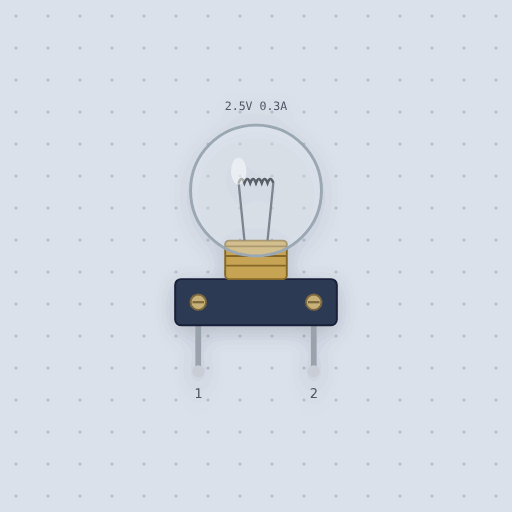
A tungsten bulb in a holder: an inrush when it is switched on cold, tens of milliseconds to warm up, and dim on half its voltage.
- 2 pins
- 1 setting
- In 16 projects
- In 1 lesson
The Filament lamp in brief
What it is, and every setting the properties panel gives it.
A miniature filament lamp is a coil of tungsten in a glass bulb, the flashlight bulb of school circuit kits, with two terminals and no polarity. It is not a resistor: tungsten’s resistance climbs with temperature, so a 2.5 V 0.3 A bulb is 8.3 ohms lit and about 0.7 ohms cold, which is what a meter on an unlit bulb reads. Mokxi models the filament’s temperature itself, so a lamp switched on cold draws roughly ten times its rated current for the first few milliseconds, glows up and fades over a 40 to 80 millisecond time constant, and on half its voltage draws about two thirds of its current while giving a tenth of its light. Past about twice its rated voltage the filament melts and, after one warning in the editor, stays open. The model property is the rating printed on the bulb: 2.5V 0.3A, 6V 60mA, 6V 0.3A or 12V 0.1A. The usual mistake is running one from an Arduino pin, good for about 20 milliamps; switch it with a transistor or MOSFET instead. Heat lost down the leads is not modeled.
- Family
- Basics
- Pins
- 2
- model
- 2.5V 0.3A (or 6V 60mA, 6V 0.3A, 12V 0.1A)
2 pins
Named as the editor names them, so a wire lands where you expect it.
How to switch a filament lamp with an Arduino
A lamp wants far more current than a pin can give, so the pin switches it through a logic-level MOSFET. The lamp goes from its own supply, here four AA cells, to the drain; the source goes to ground; the gate goes straight to pin 9. Join the cells’ minus to the Uno’s GND, because the gate voltage only means something measured from the source’s ground.
The circuit here adds a 1 ohm resistor under the source, so a volt across it is an amp and analogRead() on A0 reads the current at 4.9 mA a count. The sketch switches the 6 V 0.3 A lamp on, samples every millisecond, and prints the surge, the running current and how long the filament took to settle. The cycles after the first start warm, and surge less.
A 12 V bulb switches the same way from its own 12 V supply, and PWM on the gate dims it; the filament’s 40 to 80 ms warm-up smooths the switching into a steady glow.
What is true about the Filament lamp, here
In its help article’s own words: what the simulation gets right, and where it stops.
Modeled
Tungsten's resistance climbs with its temperature. The filament runs at about 2500 K at its rating, and its resistance goes as the temperature to the power 1.2, so cold it is about a twelfth of its hot resistance: a 2.5 V 0.3 A bulb is 8.3 ohm lit and about 0.7 ohm cold, which is what a meter on an unlit bulb reads.
Inrush. Switched on cold, a lamp draws about ten times its rated current for the first few milliseconds, until the filament heats.
Warm-up and fade. The filament's heat capacity gives it a time constant of 40 to 80 ms at its rating, depending on the bulb, so it glows up and fades over tens of milliseconds, where an LED is instant. Flick it on and off quickly and it never reaches full brightness.
It is not ohmic. The filament radiates its heat away as T^4, so on half its
voltage it runs cooler, its resistance is lower, and it draws about two thirds of
its current, not half. Its light goes as the voltage to the power 3.4: half the
voltage is a tenth of the light. Two lamps in series on one lamp's voltage glow a
dull orange; two in parallel glow fully and draw twice the current.
It burns out. Past about twice its rated voltage the filament melts. A 2.5 V bulb on 6 V flashes once and is gone, and stays open until the circuit is rebuilt. In the editor the first time is a warning: the bulb glows blinding and amber-ringed and keeps working, and a message says what voltage it had; the next time it blows.
The rated temperature and the warm-up time constants are assumptions in the range
small lamps show; the T^4 and T^1.2 laws are the textbook ones, and together
they give the empirical I ~ V^0.55 rule for tungsten lamps.
Not modeled
The heat lost down the leads and through the gas (all of it leaves as light and infrared here), so a lamp cools a little slower than a real one. The slow death of a lamp run at one and a half times its voltage: here it lives forever below about twice its rating. Color is drawn from the brightness, not computed.
From Filament lamp, in full.
See the Filament lamp in a project
16 built-in projects use it. Each opens in the editor, already wired.
Where it turns up in a lesson
One lesson places it in its own circuit.
The boards it is shown on
Each of these 2 boards has a built-in project with the Filament lamp in it.
The rest of the bench
Every one of these is drawn and simulated the same way.
Wire up the Filament lamp
Open the editor and push it into the breadboard. It is free, and it runs on your own machine.