Mini water pump
A thumb-sized submersible pump: a motor and impeller, up to 120 L/h on 6 V.
- 2 pins
- 6 settings
- In 8 projects
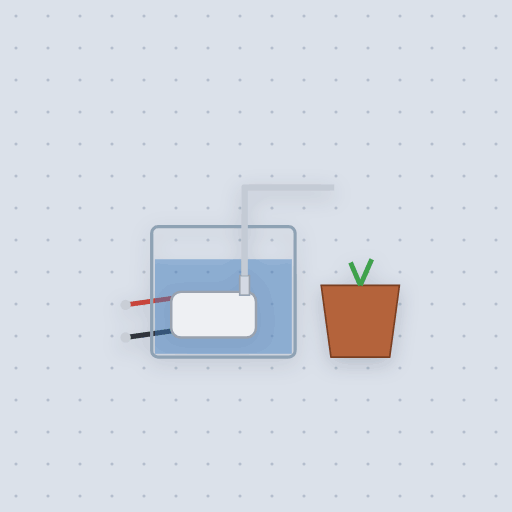
The Mini water pump in brief
What it is, and every setting the properties panel gives it.
The mini submersible water pump is a small brushed DC motor sealed around an impeller, with two leads, sold for 3 to 6 volts and 130 to 220 mA: the pump in almost every Arduino plant-watering build. Electrically it is just a motor, so it never goes on a board pin, which supplies about 20 mA. Switch it with a relay module, a logic-level MOSFET or a transistor from its own supply, and let the Uno or ESP32 only decide when. Mokxi models it as a motor with a 4 ohm winding and back EMF at 0.85 of the supply, so it draws about 220 mA running at 6 volts and far more stalled, and a 50 millisecond inertia spins the impeller up rather than instantly. Flow follows speed, up to 120 liters an hour at full voltage, so PWM through a MOSFET pumps less. The model property swaps in a 12 volt peristaltic doser, an R385 diaphragm pump or an aquarium air pump. Head height and running dry are not modeled, and a missing flyback diode is forgiven here.
- Family
- Outputs
- Pins
- 2
- model
- custom (or peristaltic 12V, diaphragm 12V (R385), air pump 12V (370))
- voltage
- 6
- flow
- 120
- resistance
- 4
- inertia
- 50
- back_emf
- 0.85
2 pins
Named as the editor names them, so a wire lands where you expect it.
How to use a mini water pump with an Arduino
The pump never goes on a pin. Here a relay module does the switching: pin 7 drives IN, the pump’s own 6 V supply goes to COM, NO goes to the pump’s V+, and V- goes to ground. The relay’s coil side and the soil probe run from the Uno’s 5 V, so the pump’s current never passes through the board at all.
The sketch reads a capacitive soil probe on A0, turns it into a percentage, and below 35% runs the pump for three seconds with digitalWrite(7, HIGH), then waits ten seconds for the water to soak in before it looks again. That wait matters: without it the sketch floods the pot chasing a probe that has not caught up. Drag the soil drier to start it.
Many cheap relay boards switch when IN is pulled low, which the relay’s trigger property models. A logic-level MOSFET module does the same job from any board, and lets PWM set the flow.
What is true about the Mini water pump, here
In its help article’s own words: what the simulation gets right, and where it stops.
Modeled
It is a motor. A stalled pump draws far more than a running one, and on a bare pin it barely turns. The flow follows the speed, so a lower voltage or a PWM duty pumps less.
Not modeled
The head (pumping higher lowers the flow), running dry (which ruins a real one), and the water. Run backwards, a real impeller pump still pushes water out, more weakly; here it pumps the same either way.
From Mini water pump, in full.
See the Mini water pump in a project
8 built-in projects use it. Each opens in the editor, already wired.
The boards it is shown on
This board has a built-in project with the Mini water pump in it.
The rest of the bench
Every one of these is drawn and simulated the same way.
Wire up the Mini water pump
Open the editor and push it into the breadboard. It is free, and it runs on your own machine.