Presence radar, LD2410
A 24 GHz radar that tells a moving person from a still one, distances and energies at 256000 baud and OUT high, for ld2410.h.
- 5 pins
- 5 settings
- In 1 project
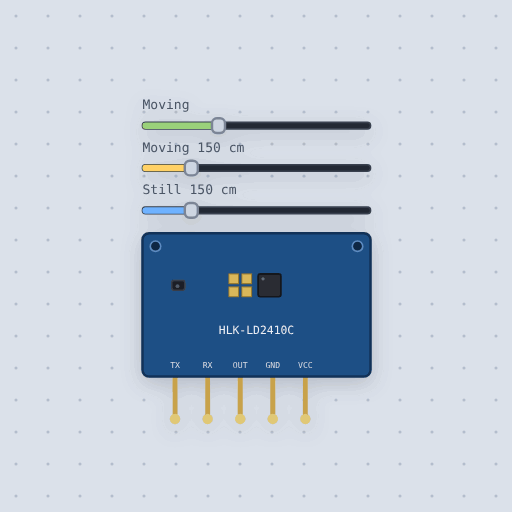
The Presence radar, LD2410 in brief
What it is, and every setting the properties panel gives it.
- Family
- Sensors
- Pins
- 5
- presence
- 1
- moving_cm
- 150
- still_cm
- 150
- moving_energy
- 60
- still_energy
- 50
5 pins
Named as the editor names them, so a wire lands where you expect it.
Output2
- TX
- OUT
Input1
- RX
Input or output2
- GND
- VCC
What is true about the Presence radar, LD2410, here
In its help article’s own words: what the simulation gets right, and where it stops.
Modeled
The frames, the commands and their answers, the configuration mode, the gates, the sensitivities and maximum gates, the no-one hold on the reports and on OUT, engineering mode, the baud rate and gate depth that wait for a restart, and the factory settings are the Hi-Link manual's (LD2410C protocol V1.00). The firmware version and MAC address are the manual's examples.
Not modeled
There is no radio: the energies are what is set, and the distances hold still where a real radar's wander. The manual gives no report rate, answer time or restart time, so the model reports every 100 ms, answers in 10 ms and restarts in 1 second. Bluetooth commands are answered but nothing goes over the air. The still sensitivity of gates 0 and 1 cannot be set, as on the real radar; here it reads 0, so a still person that close is always seen.
From HLK-LD2410 presence radar, in full.
See the Presence radar, LD2410 in a project
One built-in project uses it. It opens in the editor, already wired.
The boards it is shown on
This board has a built-in project with the Presence radar, LD2410 in it.
The rest of the bench
Every one of these is drawn and simulated the same way.
Wire up the Presence radar, LD2410
Open the editor and push it into the breadboard. It is free, and it runs on your own machine.