Gas and weather, BME680
Temperature, humidity, pressure and a heated gas plate over I2C, raw counts and calibration to work through.
- 4 pins
- 5 settings
- In 1 project
- In 1 lesson
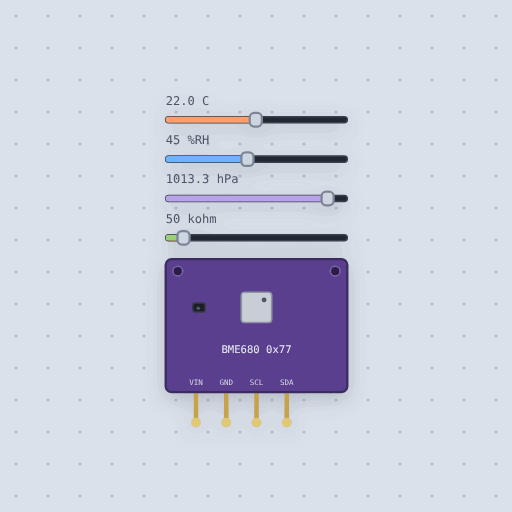
The Gas and weather, BME680 in brief
What it is, and every setting the properties panel gives it.
The BME680 is Bosch’s four-in-one environmental sensor: temperature, humidity and pressure, like a BME280, plus a tiny metal-oxide plate that the chip heats and measures. Volatile compounds in the air, from cooking smoke to solvents, lower the plate’s resistance, so a falling gas figure means worse air. That figure is a resistance in ohms, not a ready-made air quality score, and it only means something compared with the same sensor’s own reading in clean air. On a breakout it answers over I2C at 0x77 or 0x76. In Mokxi four sliders set the air, and the model runs the chip’s measurement cycle as the datasheet describes: a forced-mode cycle of the three weather readings, then the heater step and the gas reading, with the busy flag up until it ends. The results come back as raw counts, so the library’s own calibration math produces the numbers you print.
- Family
- Sensors
- Pins
- 4
- address
- 119
- temperature
- 22
- humidity
- 45
- pressure
- 1013.25
- gas
- 50
4 pins
Named as the editor names them, so a wire lands where you expect it.
How to use the BME680 gas sensor with an Arduino
The breakout needs VIN on 5 V, GND on ground, and SDA and SCL on the Uno’s I2C pins. Adafruit’s library looks for it at 0x77 by default; a board strapped to 0x76 needs that address passed to begin().
bme.setGasHeater(320, 150) asks for the plate at 320 °C for 150 ms each cycle. performReading() runs one complete cycle and fills bme.temperature, bme.humidity, bme.pressure (in pascals) and bme.gas_resistance (in ohms). The kitchen air project takes its first gas reading as the clean-air baseline and calls the air bad whenever a later reading falls below two thirds of it. Drag the gas slider on the part down to half and the bad air message appears; the weather sliders change the rest of the line.
The breakout takes 3 to 5 V and uses the board’s default I2C pins, so the same sketch runs on an ESP32 or a Pico; Bosch’s bme68xLibrary is there too if your code uses its Bme68x class.
bme.setGasHeater(320, 150);       // 320 C for 150 ms
bme.performReading();
baseline = bme.gas_resistance;    // clean air

// later, each second
bme.performReading();
bool bad = bme.gas_resistance < baseline / 3 * 2;
Common Gas and weather, BME680 errors and fixes
Questions and answers
What is the difference between the BME680 and the BME280?
The BME680 adds the heated gas plate. Temperature, humidity and pressure work much the same, and the BME280 has its own page here.
Does the BME680 measure CO2?
No. Its gas plate responds to volatile compounds in general and gives a resistance; it cannot tell which gas or report CO2 in ppm.
Why does a lower gas resistance mean worse air?
Reducing gases react at the hot metal-oxide surface and free up charge carriers, so the plate conducts better and its resistance falls.
How hot should the BME680 heater be?
The common choice, and the one the kitchen air project uses, is 320 °C for 150 ms. Keep it the same between readings you want to compare.
What is true about the Gas and weather, BME680, here
In its help article’s own words: what the simulation gets right, and where it stops.
Not modeled
The IIR filter, the heater's real temperature, and the gas resistance's dependence on it and on humidity: the gas reading is the slider's resistance.
From BME680 gas and weather sensor, in full.
See the Gas and weather, BME680 in a project
One built-in project uses it. It opens in the editor, already wired.
Where it turns up in a lesson
One lesson places it in its own circuit.
The boards it is shown on
This board has a built-in project with the Gas and weather, BME680 in it.
Arduino libraries for the Gas and weather, BME680
Built in, so the sketch compiles with nothing to install. Each page has the calls, the wiring and an example to run.
The rest of the bench
Every one of these is drawn and simulated the same way.
Wire up the Gas and weather, BME680
Open the editor and push it into the breadboard. It is free, and it runs on your own machine.